Most wholesale speaker spreadsheets start with the same three words: portable, wireless and RGB. Those labels do not help much when a buyer has to remove duplicate models or choose samples. I get a clearer result by writing the customer occasion first and then recording the supplied configuration that supports it.
Huazeng’s Bluetooth speaker range includes compact designs, larger party formats, wireless charging combinations and feature-led products. A short buying brief lets a distributor compare those formats without treating one number as a complete quality judgment.
Give every candidate a customer role
Write the intended use in one sentence: an everyday portable speaker, a feature-led desk or gift model, a party format, or a speaker that also charges a phone. That sentence tells the team where to spend sample time. A party model may need a larger enclosure and multiple speakers; a desk model may need a display, app control or charging; an everyday model may need straightforward pairing and easy carrying.
Do not create a price ladder before the roles are clear. Output power, battery capacity and feature count can help describe a model, but they do not by themselves set a retail tier, runtime result or perceived loudness.
Compare verified model data in one sheet
Keep model numbers, dimensions, supplied power, battery, controls and standout functions in separate columns. Mark each cell as confirmed, optional or still needing an answer. The examples below use facts from the current Huazeng product data.
| Model | Supplied configuration | Question for the buyer |
|---|---|---|
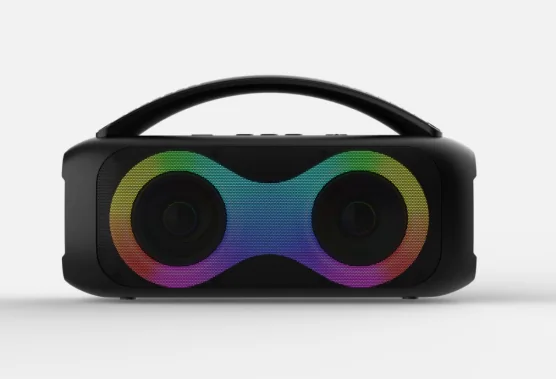
| HZ-A12 | Dual 15W speakers, 2400mAh battery, RGB lighting and 340 × 140 × 188 mm dimensions | Does the larger party format suit the shelf, use case and carrying expectation? |
| HZ-B313 | 5W speaker, 1200mAh battery, app control, TWS, RGB lighting and time display | Will customers use the app and display enough to make this a distinct role? |
| HZ-B275 | Dual 5W speakers, 1800mAh battery and 15W maximum wireless charging | Does the desk or bedside charging combination fit this channel? |
The sheet is a selection tool, not a performance claim. Battery capacity is an input and does not equal runtime under every volume, lighting and connection condition. Output power is a supplied specification and does not replace a listening test with the approved sample.
Separate core playback from feature functions
For every model, test pairing, reconnection, playback controls and charging before moving to extra functions. Then review the features that make the model different. On the HZ-B313, app setup, time display, TWS and RGB behavior each need their own check. On the HZ-B275, review audio playback and wireless charging separately before checking simultaneous use. On the HZ-A12, size, controls, lighting and the larger speaker configuration should be evaluated in the use setting described in the brief.
Use the OEM Bluetooth speaker sample evaluation article as a starting point for sound, controls, pairing and feature checks. The Bluetooth speaker OEM RFQ checklist helps capture the market, quantity, branding, packaging and sample questions that a supplier needs before quoting.
Test like the customer will use it
Before a sample session, write down the phone platforms, audio files, connection distance, volume points, lighting state and power source. Keep those conditions consistent across candidates. For a gift or desk product, I would add setup time and control clarity. For a portable party item, I would add carrying, placement, inputs and the listening levels named in the brief.
Feature comparisons should stay close to evidence. If the supplier data says a model has RGB lighting, record the modes and controls you actually confirm. If it says a speaker supports TWS or an app, check pairing and saved behavior on the approved sample. Do not turn a feature label into a result such as “strong bass,” “all-day battery” or “instant pairing” without a defined method and test record.
Ask for a model-specific quotation
Send one brief for every candidate so the responses share the same assumptions. Include the target market, sales channel, intended customer, required functions, estimated quantity, logo or private-label direction, packaging language, accessories, documents and sample deadline. Ask the supplier to identify the exact model and configuration in the reply; that small detail prevents a later mix-up.
Keep price, MOQ and lead time as project-specific quotation fields. They depend on the selected model, configuration and order brief. A term shown for one speaker should not be copied into another row of the comparison sheet.
Use a decision matrix before approving a range
Give each model one primary role and one acceptance question. For example, the HZ-B313 may need an app and display setup check; the HZ-B275 may need a charging and playback check; the HZ-A12 may need a larger-format placement and control check. If two candidates solve the same customer problem, compare the confirmed differences and keep both only when the difference matters to the channel.
Once the shortlist is approved, retain the model number, sample revision, tested configuration and approved claims in the project record. If a later revision changes the battery, speaker, control board, lighting or accessory set, repeat the relevant checks before artwork or listing copy is released.
Start with the Bluetooth speaker category, prepare the comparison sheet, and send the selected roles with your wholesale speaker inquiry. A focused brief makes supplier responses easier to compare and keeps the final range easier to explain.
Comparing Bluetooth speakers for wholesale?
Tell us your channel, target market, customer occasions, must-have features, quantity and packaging direction. We can help organize a model-specific shortlist and sample discussion.
Discuss a Speaker ShortlistFrequently asked questions
How should I compare wholesale Bluetooth speaker models?
Assign each model a customer role, record the supplied configuration, test the relevant functions under one method, and compare the quotation against the same brief.
Does a larger battery guarantee longer runtime?
No. Runtime depends on the tested configuration and conditions such as volume, lighting, connection and playback. Treat battery capacity as one input.
Should RGB lighting decide the range?
Only when the lighting supports a clear customer or channel role. Check the controls, modes and packaging explanation on the exact sample.
What should I include in a speaker wholesale inquiry?
Include the market, channel, customer use, required functions, quantity, branding, packaging, accessories, documents and sample timing.