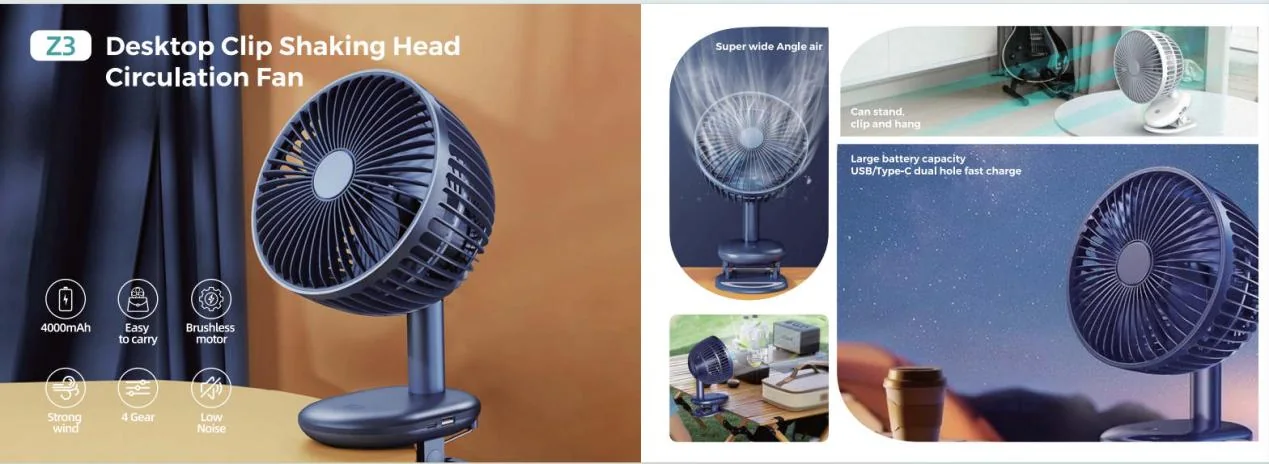
A clip-on fan only solves a space problem when its mounting method suits the place customers intend to use it. For a wholesale shortlist, define the target surface first, then compare how each model attaches, changes position and operates in that setup. A “clip-on” label by itself does not tell you whether a sample fits a shelf, desk edge or other planned location.
Huazeng’s portable fan range includes several placement formats. This guide focuses on clip-capable models and the checks that help buyers distinguish their roles before requesting samples.
Start with the surface customers will actually use
Write down the intended location: a desk edge, shelf, bedside surface or another named fixture. Measure the thickness and shape of that surface, and note what material or finish it has. Take those observations into sample review. Do not assume a product photo proves a clip will suit every edge or surface.
Also describe where the airflow should point and whether the fan will stay in one position or be adjusted often. Those details determine which angles, controls and placement modes deserve attention in the sample.
Compare placement options by model
Several products offer more than one way to position a fan, but the combinations differ. The current product information lists the HZ-Z3 with stand, clip and hanging placement, three wind gears, a 4000mAh battery and 5W rated power. The HZ-Z1B is described with base and clip-on placement, three wind gears and a 1200mAh battery. The HZ-Z11 has a two-in-one base/clip design, six wind gears, a touch-sense switch and an electric-quantity display.
| Model | Listed details | Buyer question |
|---|---|---|
| HZ-Z3 | Stand, clip or hang; three wind gears; 4000mAh; 5W | Which placement will be shown and tested for the target channel? |
| HZ-Z1B | Base and clip-on placement; three wind gears; 1200mAh | Does the base/clip choice fit the display and use story? |
| HZ-Z11 | Base/clip design; six wind gears; touch switch; electric-quantity display | Will buyers value the extra control steps and display? |
Test the attachment and adjustment as separate tasks
For each shortlisted model, record the surface used, how the clip is attached, whether it stays in the selected position and what happens when the fan head is adjusted. Repeat the same sequence across samples. Look for movement, slipping, marks on the test surface or a setup step that is difficult to explain. These are buyer-side observations, not universal performance claims.
Then test controls and airflow in the selected placement. Note whether the button or touch control is accessible and whether changing direction moves the clip or base. If a model will be repositioned regularly, include those adjustments in the sample review rather than checking only its first setup.
Keep performance comparisons tied to stated conditions
Compare the same control points and placement modes across samples. A reading or listening note from a fan standing on a desk does not automatically describe its behavior while clipped to a different surface. For noise comparisons, keep distance, room conditions, speed and setup consistent; see our portable fan noise testing guide.
Battery capacity, number of speed gears and a qualitative “low noise” label are product details, not a promise of runtime or sound level in every setting. Use the product data to build questions, then record the conditions used for your own evaluation.
Choose a role for the range and prepare the RFQ
A first assortment does not need every placement combination. Keep the model whose mounting option addresses a customer use that your existing fans do not cover. If two models are both suitable, compare their listed differences, sample behavior, dimensions, accessories and packaging basis before keeping both.
Send the target market, sales channel, intended surface, placement mode, preferred control, estimated quantity, branding and packaging requirements with the inquiry. The broader OEM portable fan buyer checklist can help organize the rest of the product brief. For a model-specific discussion, start with the portable fan inquiry.
Frequently asked questions
Does every clip-on fan fit every desk or shelf?
No universal fit follows from the clip-on label. Measure the intended surface and verify the actual sample in that setup.
Should I compare a clip fan with a desk fan?
Compare them when the buying decision is about placement, but define whether you are comparing the same surface and airflow position.
What should I record during a clip fan sample check?
Record the model and revision, test surface, placement mode, attachment and adjustment observations, control point and any sound or movement you notice.
Does a larger listed battery confirm longer runtime?
No. Runtime needs a stated test configuration and conditions; battery capacity alone does not establish it.