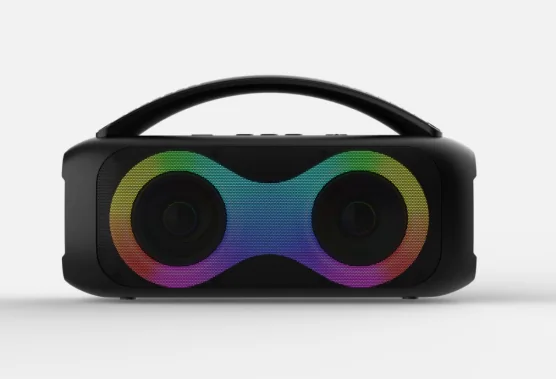
Picture the comparison sheet at the end of a sourcing meeting: six speaker rows, nearly identical descriptions, and no clear reason to keep all six. That is usually an assortment problem before it is a product problem. A range becomes easier to explain when every model earns its place by serving a different customer occasion or doing one visible job better.
Our Bluetooth speaker range spans compact portable designs, party speakers, wireless-charging combinations, display models and soundbars. That breadth is useful only when the buyer can turn it into a coherent shelf story. Start with the customer and channel; let the supplied specifications narrow the options afterward.
Start with the customer occasion, not the model number
Write a sentence about the customer’s moment: “takes calls at a desk,” “brings music outside,” or “wants a speaker that also charges a phone.” The sentence does more work than a stack of adjectives. It tells you whether size, controls, inputs, a display or charging should lead the comparison.
For a first assortment, try sketching three roles on paper: a straightforward portable model, a feature-led gift or desk option, and a larger format for another listening setting. They are not automatic price tiers. Your costing and channel margins decide where the prices belong; product selection should first establish why the products differ.
Build a comparison around differences customers can notice
Keep the comparison sheet narrow enough to use. Give each model a row for format, output, battery, inputs, standout function, dimensions and supplied accessories. In the cells, write “confirmed,” “optional,” or “not supplied” beside the source fact. A blank is useful information: it shows where a product listing or quotation still needs an answer.
| Model | Supplied configuration | Question for the assortment |
|---|---|---|
| HZ-A12 | Dual 15W speakers; 2400mAh battery; RGB lighting; 340 × 140 × 188 mm | Does the larger party format fit the display and use occasion? |
| HZ-B313 | 5W speaker; 1200mAh battery; app control, TWS, RGB and time display | Will customers use the display and app enough to justify a distinct role? |
| HZ-B275 | Dual 5W speakers; 1800mAh battery; 15W maximum wireless charging | Does the combined desk or bedside use matter to this channel? |
That table does not rank the products. It gives the team a different question for each one. Output and battery figures describe a configuration; they do not establish a retail price, runtime under all conditions, or perceived loudness. For the HZ-B313, the app and display make the sample checklist as important as the 5W speaker specification. For the HZ-A12, size and party use may decide whether it belongs in your range.
Separate core models from feature experiments
Extra functions can make a product memorable. They also create more to explain in the manual, more to test on a sample and more opportunities for the package copy to drift away from the product. Keep the core of the range simple to describe. Reserve the feature-led slot for something your customer can understand or demonstrate quickly.
Our HZ-B275 is a useful example of a combination product. The supplied specifications list dual 5W speakers, an 1800mAh battery and a maximum wireless-charging power of 15W. A desk or bedside retailer might value that combination; a travel-focused channel may not. During sampling, test sound and phone charging on their own, then test both together with the devices and power source your brief names. The charging feature is a separate buying reason, not a substitute for reviewing audio.
A model is not a useful “good, better, best” step merely because its number or output is higher. Each step should solve a different customer problem, or make a meaningful change in size, controls, connection options or use setting.
Use a decision table to remove redundant SKUs
Before you approve a shortlist, ask what one model adds that the others do not. If two models share the same use case, features and form factor, compare the specific configuration differences and consider whether both are needed for the first launch.
| Assortment role | What to prioritize | What to verify on a sample |
|---|---|---|
| Everyday portable | Size, carry method, controls, core playback | Pairing, reconnection, handling and charging |
| Feature-led gift or desk model | Display, lighting, app or charging function | Setup steps, saved settings and simultaneous functions |
| Party or larger listening format | Speaker configuration, inputs and placement | Sound at agreed volume points, controls and transport |
If you have room for only one additional SKU, choose the one whose customer, display story or use setting is least served by your current products. If the target is a desk accessory, evaluate interface-led functions. If it is a portable gathering product, evaluate size, carrying, inputs and listening performance. If the channel needs a simple entry product, resist adding functions that the customer will not use.
Check the commercial and operational fit
The shortlist still has to fit the buying plan. Check the box footprint, accessory list, dimensions, destination-market document needs, order quantity and launch date. Leave MOQ, price and lead time blank until each model is quoted against the same brief; one model’s terms cannot stand in for the whole catalog.
Use one brief for every model under consideration. Include the target market, sales channel, customer occasion, required features, quantity, branding, packaging and sample deadline. The Bluetooth speaker OEM RFQ checklist gives you a structure for preparing those inputs. Then ask for a model-specific response so you can compare the same assumptions.
Turn the shortlist into a sample plan
For each shortlisted SKU, write one acceptance question that follows from its role. A portable model may need a handling and reconnection check; an app-controlled model needs a setup and saved-setting check; a party format needs agreed listening tests. Record the sample revision and test conditions so a later change does not blur what was approved.
Keep the launch assortment small enough to explain. When a candidate does not add a distinct customer use case, remove it from the first sample round and retain it as a later option. This reduces duplicated testing and makes product pages, sales training and packaging easier to maintain.
Building a Bluetooth speaker assortment?
Send us your target market, channel, customer occasions, must-have features, quantity and launch timing. We can help identify models for a focused comparison and sample discussion.
Plan a Speaker ShortlistFrequently asked questions
How many Bluetooth speaker models should a new retail range include?
There is no universal number. Start with the customer roles the channel needs, then keep models only when they have a clear difference in use case, format or supported functions.
Should I build a good-better-best speaker assortment?
Use that structure only when each step has a defensible customer benefit and commercial position. Do not treat a higher output number as the only reason to create a higher tier.
Can battery capacity be used to compare speaker runtime?
It is one input, not a runtime result. Compare samples under the same volume, lighting, connection and playback conditions, and keep the test method beside any runtime statement.
What should I send when requesting speaker recommendations?
Include the target market, channel, customer occasion, preferred format, key functions, estimated quantity, packaging direction and launch timing.
How do I avoid choosing duplicate models?
Write the intended assortment role for each SKU. If two candidates solve the same customer problem, compare their confirmed configuration differences and retain both only when the difference matters to your channel.